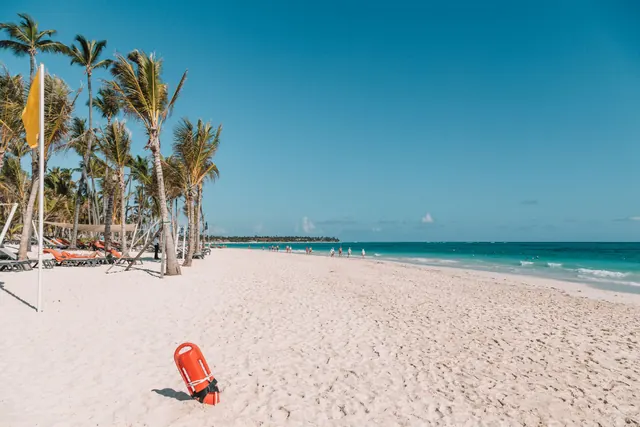
Weather, hurricane season and crowds in Punta Cana, month by month, from official climate data.
Punta Cana is warm every month of the year, so the choice is less about heat and more about three things: how much rain you are willing to risk, whether you are traveling during hurricane season, and how busy you want the resorts to be. This guide uses climate averages from NOAA and the hurricane dates from the National Hurricane Center. It does not say anything about prices, because we found no source that backs a claim about them.
What the climate data says
The numbers below are 1991 to 2020 climate normals measured at Punta Cana International Airport. NOAA publishes them, and we read them as tabulated on the Punta Cana page on Wikipedia. We converted them to Fahrenheit and inches and rounded them. A normal is an average over thirty years, so any single trip can be warmer, cooler, drier or wetter.
January and February: daily highs around 83 to 84°F and lows around 70°F. Rainfall is about 3.3 inches in January and 2.5 inches in February.
March and April: highs around 84 to 86°F, lows of 71 to 72°F. March is the driest month of the year, at about 2.0 inches. April is about 2.6 inches.
May: highs near 87°F and lows near 74°F. Rainfall jumps to about 5.1 inches, one of the wetter months.
June, July and August: the hottest stretch, with highs of 88 to 90°F and lows near 76°F. Rainfall is more moderate, about 3.3 to 4.2 inches a month.
September and October: highs around 89°F. September is the wettest month, at about 5.3 inches. October is close behind at about 4.9 inches.
November and December: highs of 87°F falling to 85°F, lows of 73 to 71°F. November is still wet, at about 5.2 inches, and December drops to about 3.6 inches.
These are monthly totals. They tell you how much rain falls in a month, not how it is spread across the days, so a wet month does not mean a washed-out week. The Dominican tourism ministry describes the climate as warm and tropical all year, with temperatures of roughly 77 to 90°F, and calls December through April the driest season.
Hurricane season
The Atlantic hurricane season runs from June 1 to November 30, according to the National Hurricane Center. Activity is highest from about mid-August to mid-October. That overlaps with the months the NOAA data shows as wettest, September and October, and November is not far behind.
The sensible approach is to treat the season as a planning risk, not a verdict. A few habits help:
Check the forecast at nhc.noaa.gov in the week before you leave, and again the day before.
Read the change and cancellation rules for your flight and your hotel before you pay, so you know what happens if a storm changes your plans.
Read what your travel insurance says about named storms. Policies differ on when coverage must be bought and what it pays for, so check the wording instead of assuming.
Keep your travel dates flexible if you can, and avoid stacking tight connections on the way home.
Crowds
The tourism ministry lists the peak seasons as December through April and the summer months. We did not find an official figure for how full the resorts are in any particular month, so treat "peak" as a general pattern. School vacations and winter holidays are when many families in the United States travel, so expect more company around those dates.
If you want a quieter trip, the shoulder periods between those peaks are the usual place to look, though that is where the rainy and hurricane-season risks are also higher. It is a trade-off between crowds and weather, and the climate table above is the place to weigh it.
Matching your trip to the season
A dry week at the beach: March has the lowest rainfall in the data, and the ministry puts the driest season at December to April.
The hottest weather: June through September has the highest daily highs, around 88 to 90°F.
Boat trips and excursions: sea conditions and weather can change a boat day, and operators decide when to sail. Ask yours how it handles a rough-weather cancellation. See our excursions guide for the main types of trip.
Whale watching: that is a different part of the country and a different season. The ministry gives January through March for humpback whales in Samaná Bay. Our Samaná page explains how people get there.
Before you pick dates
Once you know the month, look at your departure city. Each of our route pages covers the airlines and the flying time for one city, and the flight search below it lets you compare dates. Then work through the entry requirements guide for the passport rule and the e-Ticket, since the passport rule depends on when you fly.